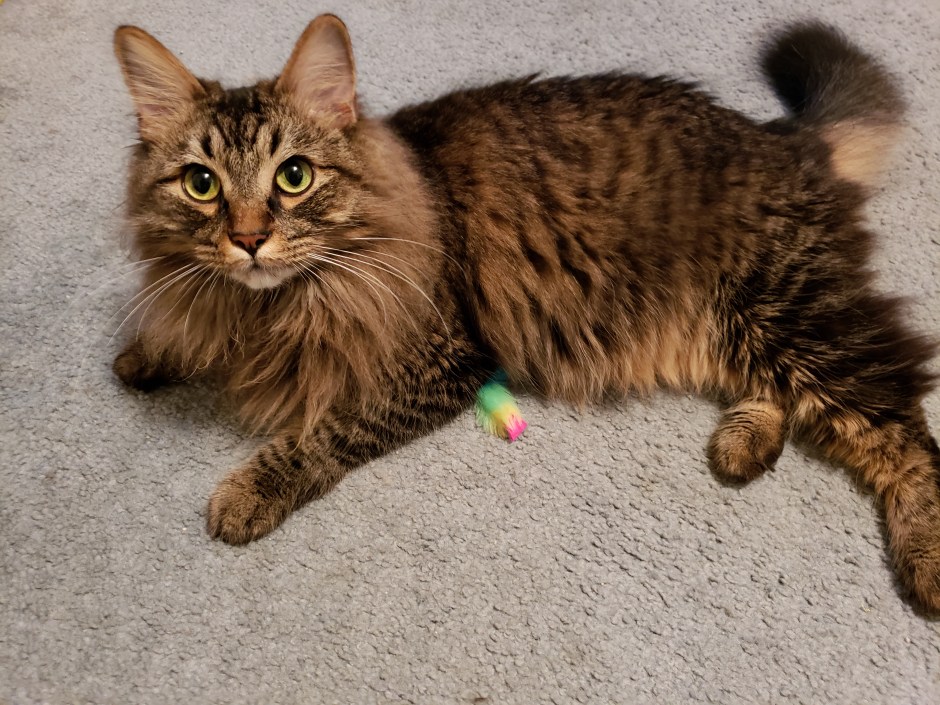
Uno was born February 20, 2017. He was a perfectly happy, healthy kitten. When he was just a couple of weeks shy of 18-months old, my dad noticed him just sitting in the kitchen with drool dripping from his mouth. I cleaned him up and figured he must have eaten a bug or something that made his mouth water. A couple of days later, my parents called me at work and said Uno was drooling again but, this time, he laid out on the floor and his legs were extended and stiff. I immediately researched the signs of seizures and knew that is what he must have had. And so the veterinarian visits began.
The morning of his first vet visit, he ended up having his first grand mal (full convulsions) seizure. Our doctor ran all the blood panels and sent out for a toxoplasmosis test. You see, the cause of the seizure can only be identified by process of elimination. All the tests proved that his liver and kidneys were perfect, he didn’t have any weird blood counts, and he was toxo-free. The next step was an MRI to check for tumors and/or inflammation. They suggested that, while he was under anesthetic, I should go ahead and run a spinal tap. Anything for my baby. Again, all of these results came back, as the doctor said, “boringly normal”. So they used the title that I do not like…Idiopathic Epileptic. Essentially a fancy way of saying they have no clue why he has seizures and my only option is to put him on anti-convulsant medication.
I worked as a receptionist for our vet for 5 years. I know Phenobarbital can help with preventing seizures but I also know it is taxing on the body. He was only an 18-month old cat; I did not want to shorten his life by giving him that drug. They ended up prescribing a newer drug called Keppra that is supposedly easier on the system. However, I wanted to research more holistic choices before starting him on the meds. After all, they said that once you start on the medication, you should not stop it for at least a year because it could make the seizures come back and, possibly, come back worse.
I ran across a post where someone said that they switched their cat to grain-free food and the seizures stopped. So I went out and purchased grain-free dry cat food. He started going 50+ days without a seizure. Then, one day, thinking he was locked away in my room, cat treats were put out. He ate some and within 24 hours he had his set of seizures. By this point, he had seizures in sets of 3 within a few hours of each other. Do not ask me what I was thinking, because I have no good answer but, after a while, I let him have bites from the other cats’ can food, which was not grain-free. Pretty soon, he was back to having seizures regularly. I knew it had to be the fact that the can food was not grain-free. Just to cover all bases, I took him to get tested for allergies. All of the tests came back normal but the vet suggested that I compare ingredients of the grain-free food with the ingredients of the can food to see if anything popped out as significantly different. The one main difference was the can cat food had “wheat gluten” in it. That is when I decided, officially, Uno is gluten-intolerant.
We became vigilant about keeping him strictly grain-free. Things were progressing well. Then I made the mistake of putting highly respected flea prevention drops on him. Within a day he had his seizures. He then had them every 6 days after that. We knew that he had not had any food influence. It had to be the chemicals. Around the fourth week, he had his 3 seizures two days in a row and 4 seizures the following day. That is when I took him back to the vet to get there opinion. He had not had them on back-to-back days in a very long time. She suggested I wipe him down with baby wipes to try to get any extra flea medication off the hair. I wiped him down. He ended up having 8 seizures that day. The time in between each seizure was gradually decreasing. When he had the eight seizure only 45 minutes after the seventh, I gave him the anti-convulsant medication. This made them stop. I said that if he had another, the next day, I would continue the medication. If he didn’t, though, I was hoping to use the Keppra as just a reset button for that night. Thankfully he did not have any more that next day.
He still had them every 6 days for a bit but now they are starting to get farther apart from each other. Then, as if the poor cat has not been through enough already, I noticed some cat litter stuck to his back foot, this past week. After cleaning the area, I discovered he had an open wound on his toe. Our vet called it a claw blowout. His claw was gone and the toe was ripped open, probably from one of the seizures. The cat litter was sticking to the wound. I am thinking this is what may have been causing the most recent seizures. He has been given an antibiotic shot and we are keeping the wound clean. So far, he has not had another seizure and it has been 10 days.
If you have a cat that ends up having seizures, the first step, of course, is to take it to the veterinarian. Some tips for when they are having a seizure, though, are as follows:
- Keep your fingers away from the mouth. They can involuntarily bite very hard.
- Pick them up and tilt the body so that the head is lower than the body. This will allow the drool to fall from the mouth instead of pooling in the throat and possibly choking the cat.
- If the seizure lasts more than 2-3 minutes, seek medical attention immediately. Extended seizures can cause permanent brain damage and potentially death.
- Know that seizures are painful for you to witness but the cat is not in any pain. Therefore, I like to keep my energy calm and just pet and kiss on him. He might not be aware of it, but I feel it is better than throwing out a panicked energy.
Watch this video to see how I handle the mid-to-late phase of the seizure. Capturing the first stage is nearly impossible because they come on so suddenly.
I hope that you never have to experience an epileptic animal but, if you do, I hope that you can find something helpful from this post.


 The Deven Times